

Yoga Nidra, Winter season and Slowing Down.


My personal story on Yoga Nidra
This week I arrived in Munich after midnight, having a crazy day of travel behind me that started at 03:30am the morning before. Planes were cancelled and delayed due to some freak hale storm in Germany.
I was super tired and there was a massively long queue at the car rental place. Everyone was visibly irritated. The person in front of me actually shouted at the poor Europcar guy, who struggled to keep cool. I'm not a patient person by nature, but somehow, standing in that queue I felt a strange sense of calmness and acceptance. I even had a short fun connection with one of the other people in the queue, a kind and helpful gentleman from Zimbabwe. In that moment I wondered if my calmness had something to do with the Yoga Nidras Ive been practicing each day this week.
At the beginning of this year, I made a simple decision: less noise. And yet, halfway through the year, my mind and my calendar still feel way too full. I've travelled a lot and the constant input, decisions and switching between roles can result in that quiet sense of overwhelm that doesn’t just disappear because I “plan better”.
But for years, Yoga Nidra seems to be the one thing which really helps me reset, especially when I travel or feel mentally stretched.
What is Yoga Nidra?
Yoga Nidra is often translated as “yogic sleep” or “conscious sleep.” At its core, it is a guided practice that brings you into a state between wakefulness and sleep, where the body can deeply relax while the mind remains gently aware.
Rooted in ancient yogic and tantric traditions and unlike more active yoga practices that focus on movement or concentration, Yoga Nidra is about effortless awareness and systematic relaxation.
Although it originates from ancient teachings, Yoga Nidra has become a widely used tool for stress reduction, mental clarity, and overall well-being.
During a session, the body appears to be asleep. However, the mind enters a state of heightened inner awareness, often accompanied by a profound sense of calm.
A central element of Yoga Nidra is the Sankalpa - a Sanskrit term meaning intention or resolve. This is a short, positive statement (such as “I am calm and focussed” or "I am safe and I am enough") that is introduced during the practice. In this deeply relaxed state, the mind becomes more receptive, allowing this intention to gently influence subconscious patterns over time.
How does Yoga Nidra work?
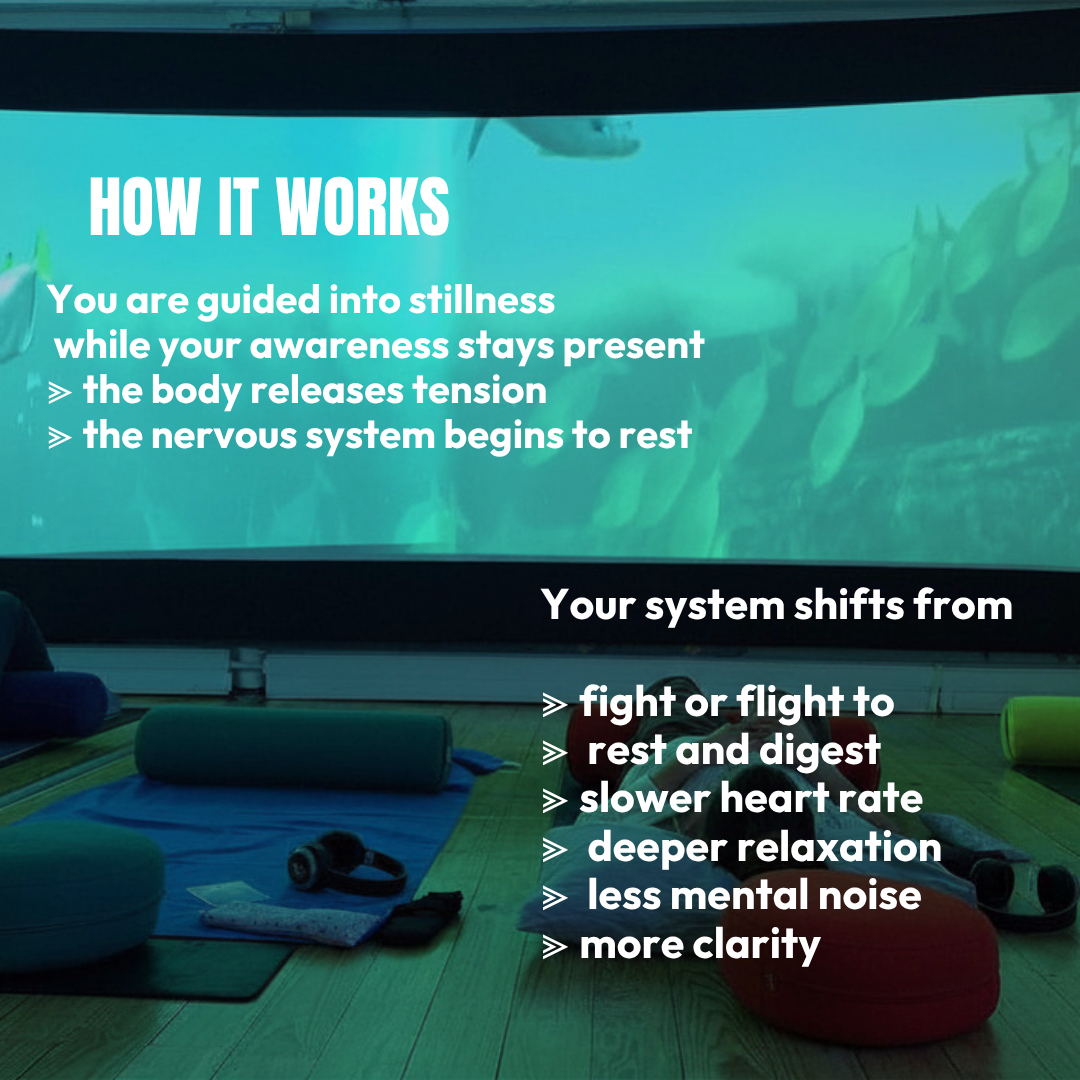
Yoga Nidra typically follows a structured sequence including body awareness, breath observation, and guided attention, all of which support the activation of the parasympathetic nervous system, the part of the body responsible for rest and recovery.
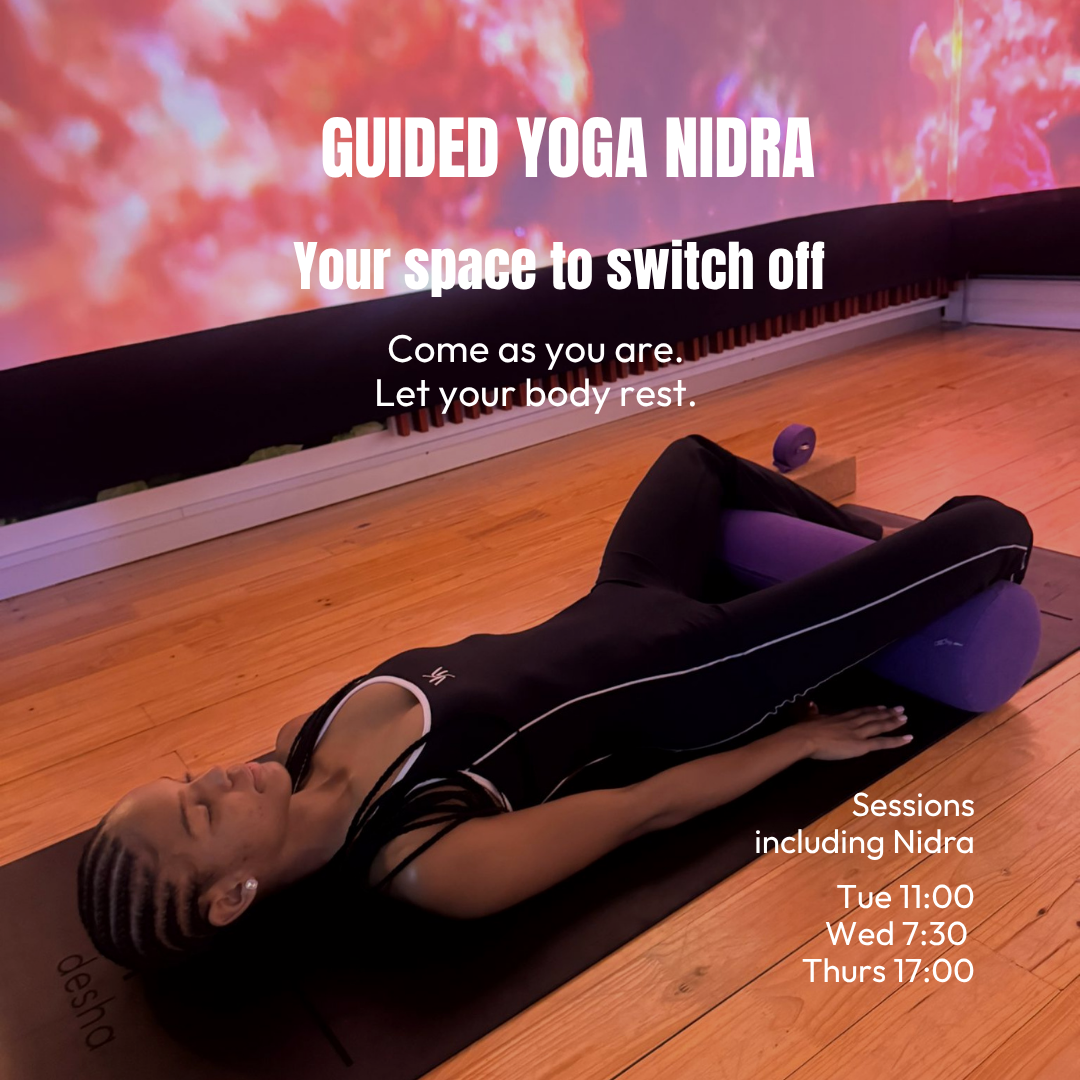
You usually practice lying down in Savasana (corpse pose), allowing the body to become completely still. Sessions can range from 10 minutes to an hour, making it accessible even in a busy schedule. I find it works best after a Vinyasa or short movement practice, but you can do it at anytime.
Brain activity also shifts during Yoga Nidra. While we are typically in beta waves during active thinking, the practice can guide the brain toward alpha and theta states, which are associated with relaxation, creativity, and subconscious processing. In deeper stages, delta waves -usually present during deep sleep- may also occur.
Some research suggests that Yoga Nidra can influence the production of hormones such as melatonin, which plays a role in regulating sleep cycles.
Benefits of Yoga Nidra
Yoga Nidra has gained increasing attention in both wellness and scientific contexts due to its wide-ranging effects.
⪢ Stress and Anxiety Reduction
Studies have shown that Yoga Nidra can significantly reduce stress and anxiety levels by calming the nervous system and lowering physiological markers such as cortisol.
⪢ Improved Sleep
Regular practice has been associated with improvements in sleep quality and may support individuals experiencing insomnia by helping the body relearn how to relax.
⪢ Mental Clarity and Emotional Balance
By slowing down mental activity, Yoga Nidra creates space for clearer thinking, emotional regulation, and improved focus.
⪢ Support for Cognitive Processing
The use of Sankalpa (intention) in a deeply receptive state may support the gradual reshaping of thought patterns and behaviours over time.
⪢ Nervous System Regulation
Yoga Nidra helps shift the body out of chronic “fight or flight” mode into a state of rest, repair, and recovery, which is essential for long-term well-being.
Rather than being a quick fix, Yoga Nidra works as a long-term regulation practice, supporting both mental and physiological balance.
Yoga Nidra for Beginners
One of the most accessible aspects of Yoga Nidra is that anyone can practice it. All you need is a quiet space and the willingness to rest. There are many guided recordings available online, and even 10 minutes can already have a noticeable effect.
Nidra for fast brains :)
Here is a guided recording of a Nidra I typically give in the studio, so you can experience the practice yourself. I tend to guide quite fast, as my brain will drift off if the guidance is too slow, so I incorporated what works best for me in here too. I would love to hear what you think.
Final Thought
Over time for me Yoga Nidra became more than just relaxation. It really makes me visibly more calm in stressful situations. It helps me deal with taxing travel schedules where I don't get enough sleep, yet still need to perform at my best. And it helps me to reconnect with myself, without effort.
At The Zense we include Yoga Nidra into almost all our classes.
Checkout the Tuesday Midday Reset Flow, Wednesday Morning Power or Thursday Ground & Flow Classes which all include Nidra practices.
Hav you tried it yet? Ill be back in Cape Town at the end of July and hope to see you in the studio soon.
thank you, Namaste.
Sources Blog: 21.April 2026
https://www.webmd.com/balance/what-to-know-yoga-nidra
https://pmc.ncbi.nlm.nih.gov/articles/PMC9033521/
https://link.springer.com/article/10.1007/s12144-020-01042-2

Comments